WP1 - Stakeholder engagement & Local Ecological Knowledge (LEK)

This WP is dedicated to developing, based on Local Ecological Knowledge (LEK) gathered through questionnaires completed by stakeholders, a monitoring plan to evaluate the fireworm (Hermodice carunculata) invasion. At the same time, the necessary permits will be obtained and stakeholders (fishers, authorities, residents) will be engaged in the project. This rapid, cost-effective approach ensures the co-production of data, thereby increasing consensus and the practical effectiveness of mitigation strategies.

Partners involved
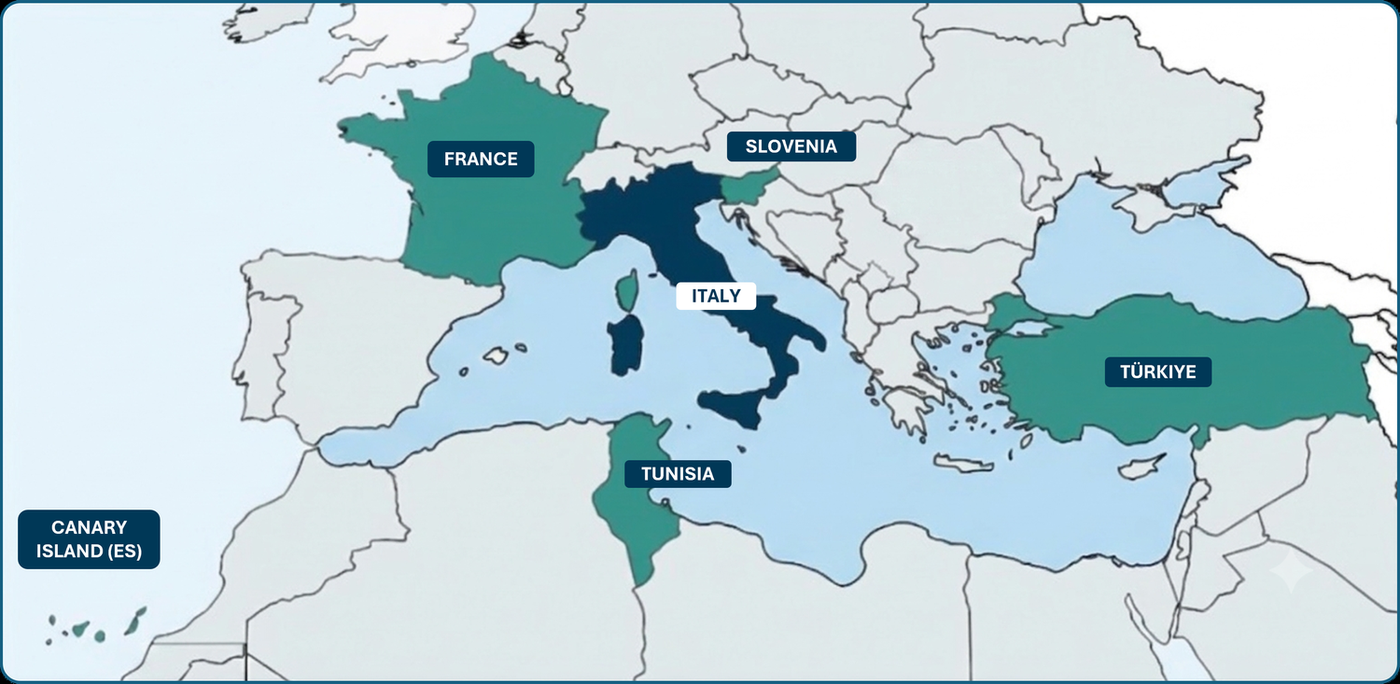
Map of WORMSOUT PLUS partner countries
  • OGS - UNIMORE - UNICT (ITA)
  • MIO (FRA)
  • JSI (SLO)
  • MSKU (TUR)
  • INSTM (TUN)
  • IUBO - IPNA-CSIC (ESP)
WP2 - Fireworms monitoring and environmental characterization

This work package aims to assess the distribution of fireworms, their correlation with environmental characteristics, and their impact on biodiversity and ecosystems throughout the Mediterranean basin and the Macaronesia region. Monitoring will be conducted over two years and will involve key stakeholders, such as diving centers and fishermen, who will be informed about the project’s objectives and how to accurately report their observations. For each country, one or at most two critical areas will be selected where environmental characterization (water and sediments) and visual census, supported by monitoring through fishing activities will be carried out. Comparability across countries and data integration will be ensured through the use of standardized protocols.

Partners involved

Map of WORMSOUT PLUS partner countries
  • OGS - UNIMORE - UNICT (ITA)
  • MIO (FRA)
  • JSI (SLO)
  • MSKU (TUR)
  • INSTM (TUN)
  • IUBO - IPNA-CSIC (ESP)
WP3 - Biodiversity genetic and socio-economic impacts

This Work Package assesses the ecological and socio-economic impact of H. carunculata on fisheries and tourism in the Mediterranean. It combines molecular analyses (molecular barcoding, stable isotopes, and biochemical analyses), field surveys to quantify direct and indirect economic losses and losses of ecosystem services by integrating perceptions and empirical data, and predictive models based on machine learning to produce maps of the spread of H. carunculata under current and future climate scenarios. The study will identify current and future areas at risk and provide practical guidance for the management and mitigation of the species.

Partners involved

Map of WORMSOUT PLUS partner countries
  • OGS - UNIMORE - UNICT (ITA)
  • MIO (FRA)
  • JSI (SLO)
  • MSKU (TUR)
  • INSTM (TUN)
  • IUBO - IPNA-CSIC (ESP)
WP4 - Mitigation strategies and valorization opportunities

This work package aims to develop targeted mitigation strategies based on the level of fireworm invasion and to investigate possible uses for their biomass. A series of experiments will be carried out to identify the most effective trap types, the optimal times of the year to intensify species harvesting (also in relation to their biological cycle), and the ideal placement time. These trials will consider different environmental conditions and worm densities, with the ultimate goal of reducing the abundance of the species in affected areas. Alternative uses of fireworm biomass will be investigated by evaluating the potential of H. carunculata as a natural bioremediation agent for fishery waste. Its antiproliferative, antimicrobial, and antioxidant properties will also be investigated, as well as the potential uses of specie in biotechnological applications, such as fertilizers or soil enhancers.

Partners involved

Map of WORMSOUT PLUS partner countries
  • OGS - UNIMORE - UNICT (ITA)
  • MIO (FRA)
  • JSI (SLO)
  • MSKU (TUR)
  • INSTM (TUN)
  • IUBO - IPNA-CSIC (ESP)
WP5 - Communication, dissemination and citizen science

This Work Package aims to ensure effective dissemination of project results, enhance public engagement (through constant updates to the website and social profiles), and support the integration of scientific evidence into environmental policy and management frameworks. Communication and dissemination activities will be implemented from the very beginning of the project (through workshops, guidelines, and deliverables) and will continue throughout its duration, following a structured, adaptive, audience-specific strategy. The approach combines digital tools and direct stakeholder engagement to maximize outreach, accessibility, and impact.

Partners involved

Map of WORMSOUT PLUS partner countries
  • OGS - UNIMORE - UNICT (ITA)
  • MIO (FRA)
  • JSI (SLO)
  • MSKU (TUR)
  • INSTM (TUN)
  • IUBO - IPNA-CSIC (ESP)
WP6 - Project management and coordination

This Work Package ensures the overall coordination, integration, and administrative management of the project, enabling the successful delivery of all activities, timely reporting, effective communication, and long-term impact. OGS, as project coordinator, will oversee the strategic and operational implementation of the project, ensuring coherence across Work Packages and alignment with the approved work plan. A Project Management Board (PMB), composed of one representative from each partner, will be set up, as well as a Data Management Group (DMG), to develop, update, and monitor the Data Management Plan.

Partners involved

Map of WORMSOUT PLUS partner countries
  • OGS - UNIMORE - UNICT (ITA)
  • MIO (FRA)
  • JSI (SLO)
  • MSKU (TUR)
  • INSTM (TUN)
  • IUBO - IPNA-CSIC (ESP)